If you have ever tried to manage a project and felt like things were slipping through the cracks — deadlines missed, scope creeping, stakeholders confused — there is a good chance the project was missing a structured approach to how work was organized.
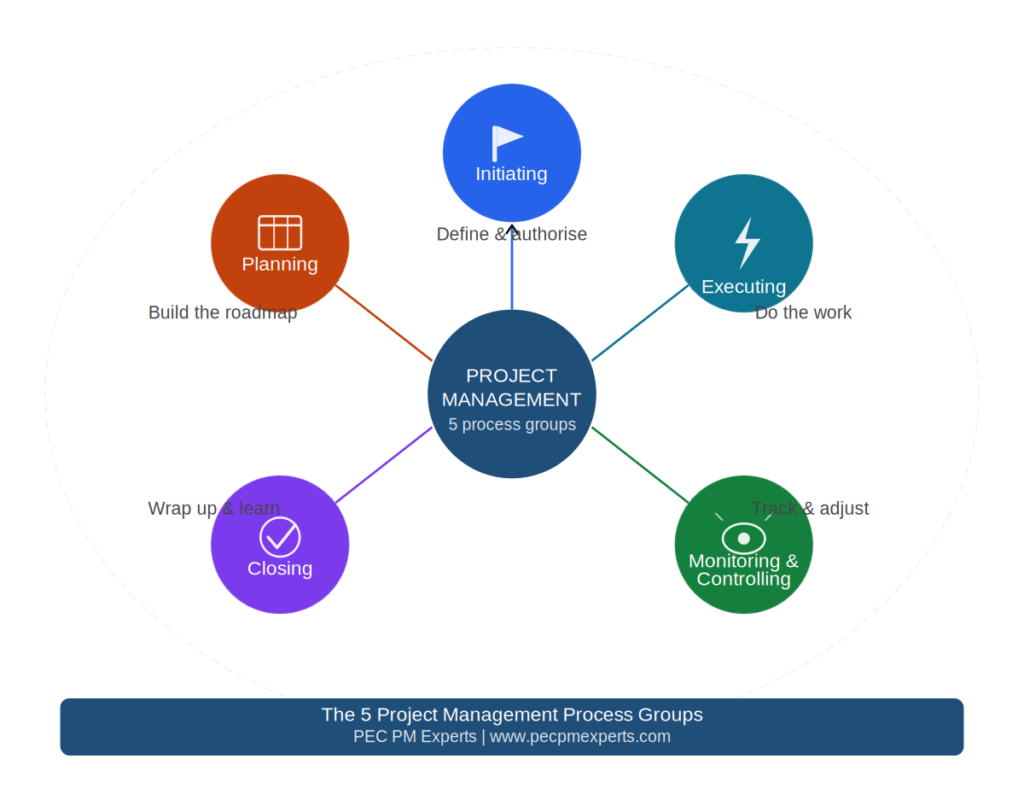
The Project Management Institute (PMI), through the PMBOK Guide, defines five Process Groups that form the backbone of effective project management. These groups are not phases in a strict timeline — they are clusters of related activities that guide how a project is managed from start to finish. Understanding them deeply is essential for any aspiring PM.
These five process groups appear across virtually all project types, industries, and frameworks. Master them and you will have the foundation to manage any project — anywhere.
PROCESS GROUP 1: INITIATING
The Initiating Process Group is where a project officially begins. Here, the project is defined at a high level, its purpose is established, and it receives formal authorization to proceed. This is where you answer the question: why are we doing this project?
Key activities in this group include:
• Developing the Project Charter — the document that formally authorizes the project and names the project manager
• Identifying key stakeholders — understanding who will be affected by or can influence the project
• Defining high-level scope, budget, and timeline estimates
• Securing sign-off from the project sponsor or governance body
Common mistake: Skipping proper initiation and jumping straight into planning. Without a clear charter and stakeholder map, projects often lack direction and authority from the very start.
PROCESS GROUP 2: PLANNING
Planning is arguably the most critical process group — and the one where new PMs tend to underinvest their time. A solid plan is your project’s blueprint, roadmap, and safety net rolled into one.
The Planning Process Group involves creating a comprehensive project management plan that covers every dimension of the project:
• Scope Management Plan — defines what is and is not included in the project
• Schedule Management Plan — lays out the timeline, milestones, and dependencies
• Cost Management Plan — estimates the budget and tracks expenditure
• Risk Management Plan — identifies potential risks and mitigation strategies
• Quality Management Plan — defines quality standards and how they will be measured
• Communications Plan — determines who gets what information, when, and how
• Resource Management Plan — identifies the people, tools, and materials needed
The output of this group is a baseline that the project will be measured against throughout its life. If your plan is weak, your execution will be chaotic.
Pro Tip: The more time you invest in planning, the less time you spend firefighting during execution. Great PMs are obsessive planners.
PROCESS GROUP 3: EXECUTING
This is where the rubber meets the road. The Executing Process Group is where the actual project work gets done. As the PM, your job shifts from planning to leading — coordinating people, managing vendors, communicating with stakeholders, and ensuring quality at every step.
Key activities include:
• Directing and managing project work according to the project plan
• Managing the project team — assigning work, resolving conflicts, building morale
• Procuring goods and services from external vendors
• Managing stakeholder engagement and expectations
• Implementing approved changes and corrective actions
• Ensuring quality assurance processes are followed
Execution is where most of the project budget is spent and where the real leadership skills of a PM are tested. The ability to keep a team motivated, resolve conflicts, and maintain momentum through challenges is what separates good PMs from great ones.
PROCESS GROUP 4: MONITORING & CONTROLLING
Here is something many beginners do not realise: Monitoring & Controlling runs in parallel with all other process groups — including Planning and Executing. It is not a phase that comes after execution; it is a constant, ongoing activity throughout the project.
This process group involves tracking, reviewing, and reporting project performance to ensure the project stays on track against the approved baseline. Key activities include:
• Monitoring project performance using Key Performance Indicators (KPIs)
• Comparing actual progress against the planned schedule and budget
• Performing Earned Value Management (EVM) to assess cost and schedule performance
• Identifying variances and taking corrective or preventive action
• Managing and controlling changes through a formal change control process
• Monitoring risks and implementing risk responses as needed
Key insight: The earlier you catch a problem, the cheaper it is to fix. A robust monitoring system is your early warning radar.
PROCESS GROUP 5: CLOSING
Every project must come to a formal end — and the Closing Process Group ensures it does so properly. Many PMs treat closing as an afterthought, but it is one of the most valuable phases of the project lifecycle.
Proper project closure involves:
• Verifying that all deliverables have been completed and accepted by the customer
• Obtaining formal sign-off and project acceptance
• Releasing project resources and closing out contracts with vendors
• Archiving all project documentation for future reference
• Conducting a lessons-learned session with the team
• Celebrating the team’s success and acknowledging contributions
The lessons-learned session deserves special mention. This is where you document what went well, what did not, and what you would do differently next time. This institutional knowledge is gold for future projects.
A project that ends well sets the foundation for the next one. Never skip the closing process group.
How the Five Process Groups Work Together
It is important to understand that these process groups are not always sequential. In practice, a project manager may revisit planning after monitoring reveals a major variance. Closing activities can overlap with executing if different workstreams finish at different times.
Think of the five process groups not as a straight line, but as an interconnected system — each feeding into and influencing the others throughout the life of the project.
Why This Matters for Your PM Career
The five process groups form the foundation of the PMP (Project Management Professional) examination — the world’s most recognized project management certification. Whether you are studying for the PMP, the CAPM, or simply trying to become a better project manager, a deep understanding of these groups is non-negotiable.
At PEC PM Experts, we structure our training around these process groups to give our students a systematic understanding of how projects work — and how to manage them effectively from initiation to closure.
MASTER ALL 5 PROCESS GROUPS WITH PEC PM EXPERTS
Visit www.pecpmexperts.com to start your PM certification journey